How to Find a Reliable Acetate Eyewear Supplier in China
Finding an acetate eyewear supplier in China is not difficult.
The real challenge is finding one that is reliable for long-term business.
Different suppliers may show very similar products. Their prices may also be close. But their real production ability, quality stability, lead time and problem-solving ability can be very different.
For small and medium-sized eyewear brands, price should not be the only factor. Before your first order, here are several important things to check when choosing an acetate eyewear supplier in China
.
1. Check Whether the Supplier Really Has Acetate Eyewear Production Capability
Many eyewear suppliers show different product categories, such as acetate, TR90, metal and sports eyewear.
But this does not always mean that every product category is made in the same factory.
Unless it is a very large factory, different eyewear categories usually need different machines, production lines and workers.
Trading companies are not necessarily a problem.
But buyers should know where their products are really made and which production steps are completed by the core factory.
For acetate eyewear, you can check:
- Is acetate heating and shrinkage control done by the core factory?
- Does the factory have CNC equipment?
- Where are grinding and polishing completed?
- Are hinges installed inside the factory?
- Are final assembly and frame adjustment done in-house?
- Which processes are outsourced?
If many key processes depend on outside factories, quality control and delivery management can become more difficult.
SFC works closely with an acetate eyewear factory in Shenzhen.
The factory can complete all core production processes, from acetate processing to finished eyewear, inside one factory.
This is one of the main reasons we chose it as a long-term partner.
2. Do Not Only Look at Product Catalogs. Check Real Production
Good product photos are easy to get.
Real production capability needs more proof.
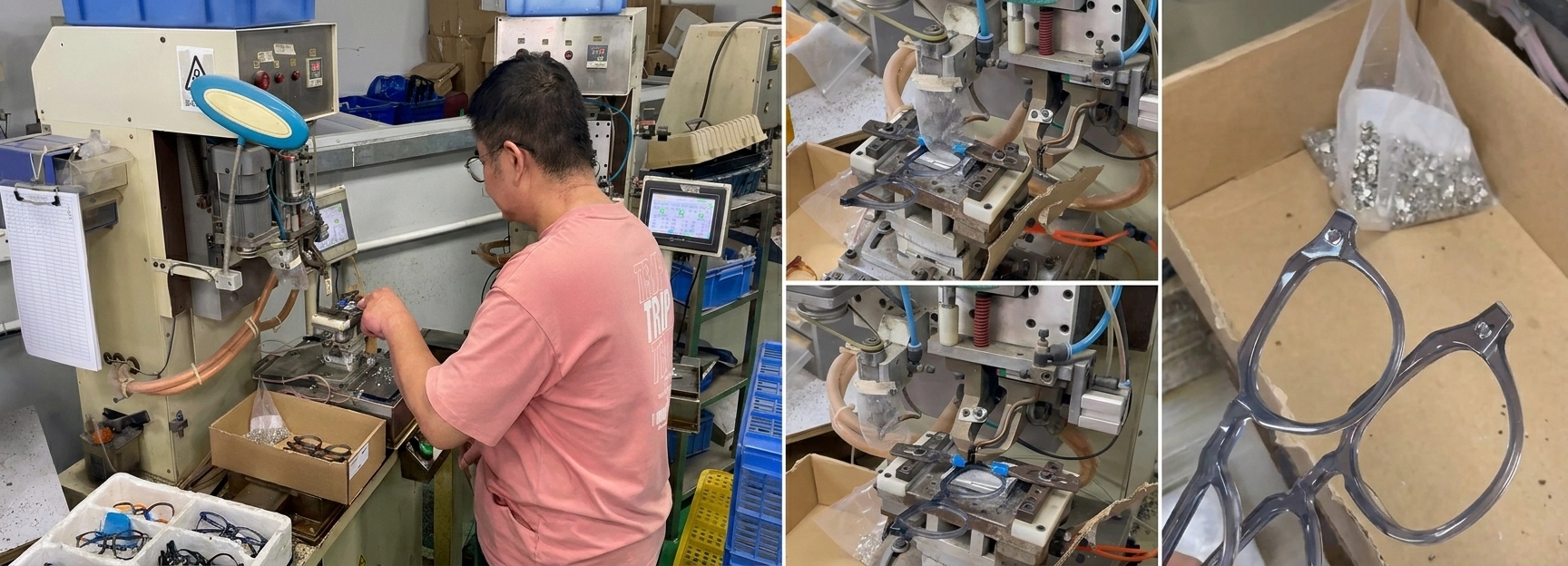
Before starting cooperation, buyers can ask for recent production photos or videos, such as:
- CNC machining
- Semi-finished acetate frames
- Grinding and polishing
- Hinge installation
- QC inspection
- Products currently in mass production
For larger or long-term projects, a factory visit can also be useful.
Overseas buyers cannot travel to China for every order.
This is where a local sourcing team can help.
SFC is based in Shenzhen. When needed, we can visit our partner factory, check production and send real photos, videos and problem reports to the customer.
3. Check Whether the Factory Has Made Similar Products Before
Do not only ask:
“Can you make this style?”
Most suppliers will answer:
“Yes.”
A better question is:
“Have you made similar products before?”
For example, you may want to develop:
- Thick acetate frames
- High-clear transparent acetate
- Layered or mixed-color acetate
- Special temple structures
- Special logo methods
- High polishing requirements
It is better to check whether the factory has real experience with similar products.
Experienced factories can reduce trial and error during sampling.
If a factory has worked with European and American eyewear brands for a long time, it will usually be more familiar with international requirements for size, appearance, packaging and quality.
4. Check Factory Audits and Compliance
When a buyer only orders a few hundred pairs for the first time, factory audits may not seem very important.
But this can become important when the brand grows.
For example, large retailers, department stores or more established customers may ask for social responsibility audits or factory documents.
Before choosing a long-term supplier, you can check:
- Has the factory passed third-party audits?
- Are the reports still valid?
- Does the company name on the report match the real factory?
- Does the factory have social responsibility audits?
- Does it have experience with international brands?
SFC’s core acetate eyewear partner has relevant social responsibility certification and factory audit experience. This can reduce the risk of changing suppliers later when the customer’s business becomes larger.
5. Start With a Small Order for the First Cooperation
Even if you have already checked the factory, samples, quotation and documents, it is still better to control the first order size.
You are not only testing the product.
You are also testing:
- Sampling speed
- Communication efficiency
- Quality control
- Packaging improvement
- Delivery time
- How problems are handled
Our partner acetate eyewear factory can support test orders from around 100 pieces, depending on the style.
A brand can test one new style first.
If the market response is good, the next order can be larger.
This reduces inventory risk and also helps the buyer test the supplier through a real order.
For more details, see how a small acetate eyewear test order can be used to test a new style before increasing order quantity.
6. The Lowest Quotation Does Not Always Mean the Lowest Sourcing Cost
Imagine two factories quote the same eyewear style:
Supplier B: USD 8
This does not automatically mean Supplier A is cheaper.
First, check whether the specifications are really the same.
For example, the lenses may use:
- TAC
- CR39
- Nylon
CR39 and Nylon lenses may also include a polarized function.
Other factors can also change the price, such as:
- Acetate material
- Hinges
- Logo method
- Polishing requirements
- Packaging
- MOQ
A cheaper supplier may also create extra costs if quality or delivery problems happen often.
These costs can include:
- Rework
- Defective products
- Extra inspection
- Delayed shipment
- Changes to international shipping plans
So the real comparison should be:
Price under the same specifications + quality stability + delivery time + service ability
Do not compare only the unit price on the quotation. Buyers should also understand what to check before ordering acetate eyewear
7. Watch How the Supplier Handles Problems
This is one of the most important ways to judge whether a supplier is reliable.
No eyewear production can be 100% free from problems.
During production, problems may include:
- Acetate material color differences from the approved sample
- Poor polishing
- Packing mistakes
- Delivery delays
The real question is not:
“Will this factory never make a mistake?”
The real question is:
“Can they find, communicate and solve the problem quickly?”
This is especially important for overseas buyers.
If you can only follow production by email or chat, it can be difficult to know whether the factory’s update matches the real situation.
SFC does not replace the factory.
The factory is responsible for manufacturing.
SFC works as a third-party supply chain management team in China.
Depending on the project, we can help with:
- Production follow-up
- Product inspection
- Factory communication
- Third-party testing
- Export
- Shipping
If mass production is clearly different from the approved sample, we can also visit the factory and check the real situation.
For small and medium-sized eyewear brands without their own sourcing office in China, local supply chain management can reduce communication and quality risks.
What Makes a Reliable Acetate Eyewear Supplier in China?
Reliable does not always mean the biggest factory.
It also does not mean the lowest price.
For small and medium-sized eyewear brands, more important factors are:
Real production capability, stable quality, reasonable MOQ, continuous product development, compliance documents and strong problem-solving ability.
The first cooperation can start with a small order.
If the supplier can complete the first, second and third orders well, the buyer can gradually increase the order volume.
In the long term, a stable and reliable supply chain partner usually creates much more value than saving a small amount on each pair of eyewear.
Looking for a Reliable Acetate Eyewear Supplier in China?
Learn more about our Shenzhen partner factory, low-MOQ test orders, new acetate eyewear styles and China-side sourcing support.