Custom Acetate Eyewear Samples, From Prototype to Production Approval
When custom acetate eyewear samples arrive, brands usually look first at the shape, color and fit. Before replying, “Sample approved. Please start production,” one point needs to be clear: are you approving the frame design, or the production standard for the complete pair?
A development sample may use temporary lenses, a similar acetate color or standard hardware. If the brand and the factory understand the approval differently, these details can lead to disagreements later.
Effective sample approval brings together the physical sample, CAD engineering drawings and files, and a clear list of required changes. Both sides need to know what has been approved and what must be resolved before bulk production begins.
1. Define what the sample is being approved for
Samples serve different purposes at different stages. Some help confirm shape and proportions, some are used to assess fit, and others are submitted for final production approval.
When reviewing a sample, ask the supplier to identify:
- Parts made with the final production materials and processes.
- Temporary materials or substitute components.
- Details that still need improvement before final production, how they will be corrected, and whether a revised sample is needed.
- The specific items that require the brand’s approval at this stage.
For example, if the frame shape is correct but the lens color is temporary, record: “Frame shape approved; lens color pending approval.” This is easier to follow than a general “Sample approved.”
Production steps involving unapproved details should wait until both sides have agreed how to proceed.
For a broader purchasing checklist, see what to check before ordering acetate eyewear.
2. Confirm the acetate supplier and material code
“Black acetate” or “light tortoiseshell” is not a complete material specification. The same color description may cover different levels of transparency, pattern sizes, sheet thicknesses and material suppliers.
During sample review, record the acetate supplier, material code, sheet thickness and physical reference where possible. For multilayer acetate, also confirm the layer colors, their orientation and the effect expected after machining.
For patterned acetate such as tortoiseshell, reference samples help define the overall color and pattern style. They do not mean that every marking will appear in exactly the same position on every frame. Agree on an acceptable range of variation and keep several representative samples if needed.
3. Agree on measurement methods and tolerances
Check the sample against the latest drawings and dimension sheet. Agreed measurements may include lens width, bridge width, temple length, overall frame width and lens height.
Simply writing “145 mm temple length” can still leave room for different interpretations. Both sides should agree on the measurement points, method and permitted tolerance so that they measure the same feature in the same way.
Alongside the measurements, assess the fit of the physical frame. Is it too wide? Does the bridge fit comfortably? Are the temple bends and opening angles suitable for the intended wearer?
Keep both the measurement results and the fit comments for revisions and repeat orders.
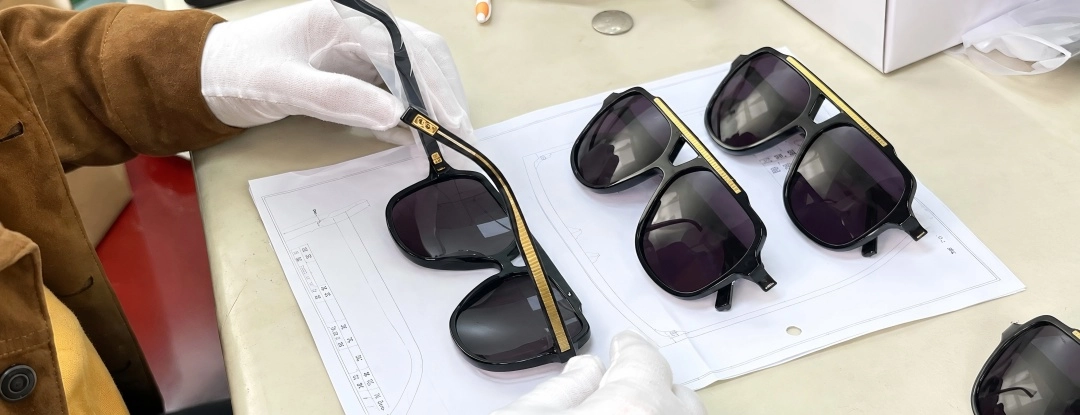
4. Check assembly, alignment and hardware from several angles
A front-view photo does not show the full condition of a frame. Check it from the front, side and top, with the temples open and folded. Compare the rims, temple angles, bridge position and overall assembly with the approved design.
Placing the frame on a flat surface can help reveal alignment issues, but this check alone does not establish how well it fits.
Review the hardware separately, including:
- The hinge type and whether it is securely fitted.
- Whether either temple feels noticeably loose or too tight when opened and closed.
- Screws and other fasteners.
- The design, position and metal color of the temple core wires.
- Metal logos and other custom components.
A visual check and a few opening and closing movements only show the assembly condition at that time. If the project has durability requirements, agree on separate tests and acceptance criteria.
5. Record logo and lens approval separately
Check the logo against the final artwork. Confirm the application method, dimensions, position, orientation and color. Use fixed reference points to describe its position instead of relying only on how it looks in a photo.
Also check the model number, size markings and other text inside the temples. The outside branding may be correct while the inside markings still use an older version.
For lenses, confirm both appearance and specifications. Record the material, whether polarization is required, coatings and any agreed performance requirements. For gradient lenses, confirm the direction of the gradient and the depth of tint.
Use physical references to approve color. Verify performance through the agreed documentation or test results; it cannot be established from a photo or the darkness of the tint.
6. Set clear surface finish acceptance criteria
Polishing and edge finishing affect the appearance and feel of acetate eyewear. Under consistent lighting, inspect the rims, bridge, corners and temples for scratches, visible machining marks, local surface waviness or edge finishing that differs from the design.
Keep separate references for gloss and matte finishes. Requests such as “make it shinier” or “make it look more premium” are not enough on their own.
For appearance issues that may be difficult to judge, use close-up photos and written defect descriptions to show what is acceptable and what needs rework. Photos explain the location and issue; the physical sample provides a reference for the actual finish.
7. Use the approved sample together with written specifications
The final approved sample, often called a golden sample, should be used alongside written requirements. The physical sample shows appearance and assembly. The documents define dimensions, tolerances, materials and other requirements that cannot be judged by sight alone.
A useful approval record includes:
| Item | Information to record |
|---|---|
| Sample identification | Model number, color code, revision and date |
| Materials and components | Acetate, lenses, hinges and custom components |
| Dimensions | Drawing revision, measurement methods and tolerances |
| Branding | Logo artwork, application method and positioning requirements |
| Approval status | Confirmed items, required changes and review method |
| Approval references | Corresponding samples, documents and written approval |
If both sides keep reference samples, confirm that they represent the same approved revision. Also agree how to resolve any conflict between a sample and a document, so the factory does not choose the reference on its own.
8. Confirm revisions before releasing the related production steps
When changes are needed, describe the exact location, target requirement and review method.
Instead of “The logo is not right,” write: “The logo on the outside of the temple does not match the approved artwork position. Please correct it and provide a photo with measurements for review.”
Changes to materials, construction, dimensions or fit will usually need another assessment of the revised physical sample. After approval, update the sample or document revision so production and inspection use the same references.
The approved sample is the starting point for bulk quality control. Materials, work in progress and finished frames still need to be checked against the agreed requirements during production.
9. Work with SFC to simplify sample development
Your brand does not need every production detail ready before starting. To get started with SFC’s acetate eyewear sourcing support in China, share a few core pieces of information:
- Your style direction, such as a design drawing, reference images or a physical sample.
- Your logo and main requirements for color, fit or function.
- Your expected order quantity, target budget and preferred delivery date.
You can start with your current ideas even if you do not have complete drawings or have not selected the acetate, lenses and hardware. SFC helps clarify your requirements and discusses practical options with the factory. We turn your design direction into specific material, dimension, process and sample requirements.
During sampling, SFC follows up on progress, checks samples against your requirements, records the changes needed and coordinates revisions with the factory. Your team can focus on key decisions about the style, branding and final sample, with less time spent chasing production details and passing revision comments back and forth.
Once the final sample is approved, SFC organizes the approved sample and matching specifications as references for bulk production and quality inspection. We continue following up with the factory, giving your brand a consistent partner to coordinate the details from sampling through production.
Have an acetate eyewear idea but no complete production plan yet? Send SFC your reference style and core requirements. We can help develop the details, follow up on samples and coordinate production.