How to Find a Reliable Clothing Manufacturer in China
China has a large number of clothing manufacturers.
For overseas brands, the real challenge is not simply finding a factory.
The challenge is finding the right factory for your business.
A very large factory may not be suitable for a small brand that is just starting production.
A factory with the lowest price may also not be the best choice for long-term cooperation.
Before looking for suppliers, it is important to understand your product, order quantity, quality level and sourcing needs.
If you are new to purchasing apparel in China, understanding the overall sourcing process first can also make supplier selection much easier.
1. First, Know What Type of Factory You Need
“Clothing factory” is a very broad term.
Different factories may specialize in different products, such as:
- T-shirts
- Hoodies
- Sweatpants
- Activewear
- Leggings
- Jackets
- Swimwear
- Underwear
- Knitted garments
- Woven garments
A factory that is strong in basic knitted T-shirts may not be suitable for high-stretch activewear.
A large sportswear factory may also not want to handle a small test order from a new brand.
Before searching for suppliers, it is better to prepare some basic information:
- Product type
- Estimated order quantity
- Fabric requirements
- Target price
- Target market
- Quality requirements
- Packaging requirements
- Certification requirements, if any
The clearer your requirements are, the easier it is to find the right factory.
2. Do Not Judge a Supplier Only by Alibaba or Its Website
Online platforms are a useful way to find suppliers.
But they do not always show the real production capability of a company.
A supplier with a professional website may actually be a trading company.
At the same time, some Chinese factories with strong production capability may have a very simple English website, or no English website at all.
So buyers should look beyond product photos and quotations.
It is useful to check:
- Company information
- Factory address
- Main product categories
- Production equipment
- Workers and production lines
- Main export markets
- Factory audits or certifications
- Which processes are done in-house
- Which processes are outsourced
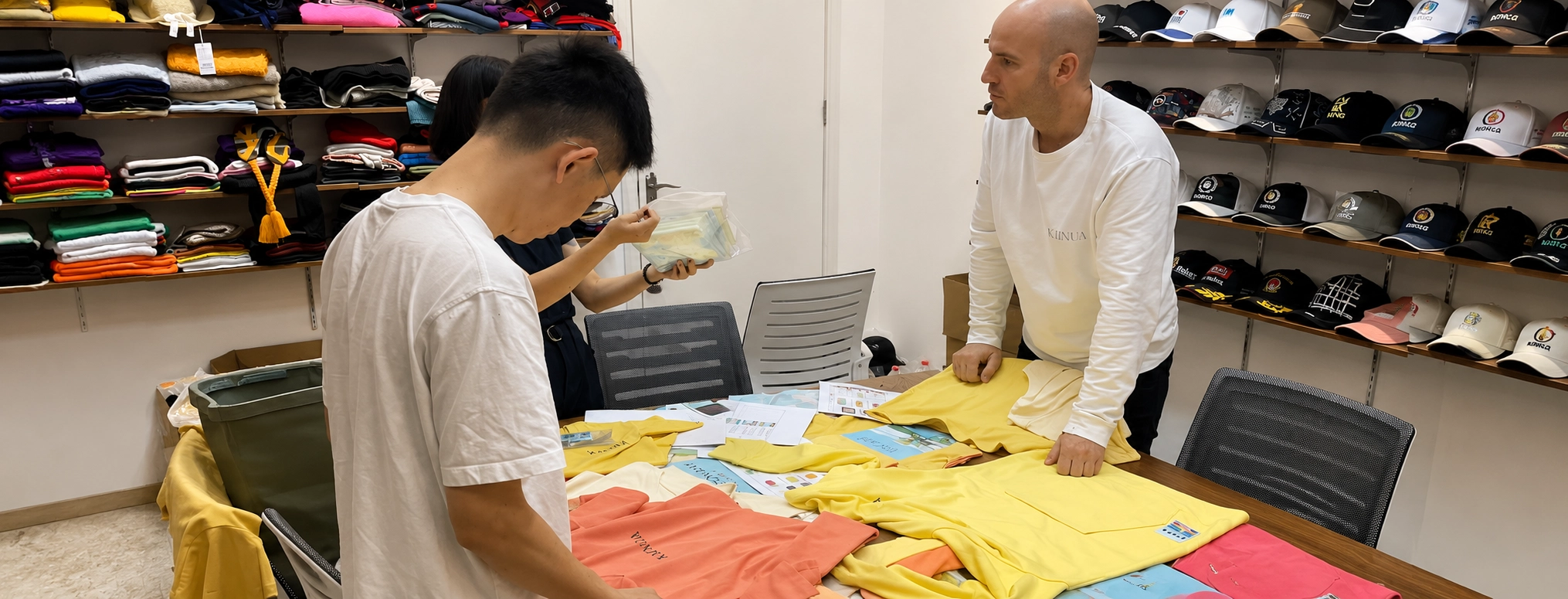
If possible, buyers can arrange a video factory tour or an on-site factory visit.
3. Choose a Factory That Matches Your Order Size
Many buyers think:
“The bigger the factory, the better.”
This is not always true.
For example, imagine a new brand wants to place an order of:
500–1,000 pieces.
If the factory normally works on orders of tens of thousands or hundreds of thousands of pieces per style, your order may not be a priority.
A medium-sized factory that matches your order volume may give your project more attention.
When choosing a factory, buyers should consider:
Product match + order size + quality requirements + lead time
Do not only focus on factory size.
4. MOQ Depends on More Than the Garment Factory
Overseas brands often ask:
“What is your MOQ?”
But clothing MOQ is rarely just one fixed number.
For example, producing 500 T-shirts may be easy if the factory can use an existing standard cotton fabric.
But the situation may change if you need:
- Special GSM
- Custom colors
- Organic cotton
- Recycled polyester
- Special functional fabrics
The fabric supplier may have its own MOQ.
In reality, clothing MOQ can depend on:
Garment factory MOQ + fabric MOQ + dyeing MOQ + trims MOQ
For a new brand, the best solution is not always finding the factory with the lowest MOQ.
Sometimes the order can be made more practical by adjusting:
- Fabric choices
- Number of colors
- Number of styles
- Quantity per style
5. Do Not Compare Only the Garment Unit Price
Imagine:
Factory B: USD 8.80
Factory A looks cheaper.
But the two prices may not be comparable if the factories use different fabric weights, yarns, dyeing methods, trims or quality standards.
A useful quotation comparison should be based on similar specifications, such as:
- Fabric composition
- GSM
- Color
- Size range
- Printing or embroidery
- Labels
- Packaging
- Quantity
Otherwise, a low price may come from a lower product standard.
Common Risk
The sample looks good, but the bulk production uses lower-cost materials to meet the low price.
6. The First Sample Is Very Important
A sample is not only used to check whether the style looks correct.
It also helps create the standard for bulk production.
Buyers should carefully check:
- Measurements
- Fit
- Fabric
- GSM
- Color
- Hand feel
- Printing or embroidery
- Logo
- Washing performance
- Packaging
After the final sample is approved, bulk production should follow the confirmed standard as closely as possible.
If there are still many problems during the sample stage, it is usually better to solve them before starting mass production.
7. Quality Control Should Start Before Final Inspection
Many overseas brands only arrange a final inspection after all products are finished.
This can find problems.
But sometimes it is already too late.
For example:
If 1,000 garments are already finished before anyone notices that the print position is wrong, rework can become difficult and expensive.
A better approach is to check quality at important production stages.
Fabric confirmation → PP Sample → Bulk production → Inline inspection → Final inspection
Not every order needs a very complicated inspection process.
But the larger and more complex the order is, the more important it becomes to check quality earlier.
8. If You Use Sustainable Materials, Check the Certification Carefully
For a conventional clothing brand, this may not always be necessary.
But if your brand sells products made from:
- Organic cotton
- Recycled polyester
- RPET
- Recycled nylon
- Other sustainable materials
you should not only accept a supplier saying:
“Yes, this is organic.”
Buyers should also check the material source and related certification.
For example, when buying organic cotton, the supply chain may need to provide relevant GOTS or OCS documents.
For recycled materials, buyers should also check the correct supporting documents based on the product claim and target market.
SFC has experience sourcing sustainable fabrics and materials for apparel and accessories.
Sustainable and eco-friendly sourcing is one of SFC’s key sourcing strengths.
However, this does not mean we only work with sustainable brands. We also support conventional apparel sourcing using common materials such as cotton, polyester, nylon and spandex.
9. A Good Factory Still Needs Good Supply Chain Management
Finding a good factory is only the first step.
During a real production project, many other issues may appear, such as:
- Fabric delays
- Sample changes
- Color problems
- Packaging changes
- Production scheduling
- Quality problems
- Testing
- Shipping
- International logistics
For overseas brands without a China office, managing all of these issues remotely can be difficult.
This is where a third-party sourcing team can help.
SFC is not a single clothing factory.
We work more like a third-party supply chain management team in China for overseas brands.
Depending on the project, we can help with:
- Finding suitable factories
- Comparing suppliers
- Price negotiation
- Sample follow-up
- Production follow-up
- Quality inspection
- Third-party testing
- Packaging
- Export
- Shipping
The buyer is not limited to the capability of only one factory. If one factory is not suitable for a project, other supply chain options can be considered.
The Best Factory Is the One That Fits Your Business
When looking for a clothing manufacturer in China, buyers should not only ask:
“Who has the lowest price?”
A better question is:
“Who is suitable for my product and my current business size?”
For a new brand, MOQ, communication and flexibility may be more important.
For a fast-growing brand, capacity, stable quality and lead time may become more important.
For a sustainable brand, material traceability and certification may also become key requirements.
There is no single factory that is perfect for every brand. The better approach is to understand your own needs first, then find the factory and sourcing structure that match those needs.
Looking for Apparel Sourcing Support in China?
SFC helps overseas brands find suitable factories, manage samples and production, control quality, verify sustainable materials when needed, and coordinate shipping from China.